From the hives · September 6, 2026 · 4 min read
Two million flowers: what it takes to make one pound of honey
The jar on your counter is the work of tens of thousands of bees over a few weeks of summer. A look at the arithmetic of a pound of honey.
A one-pound jar of honey fits in your hand. It is easy to forget what it represents. Here are the numbers, as close as anyone can count them, and what they mean.
The flowers
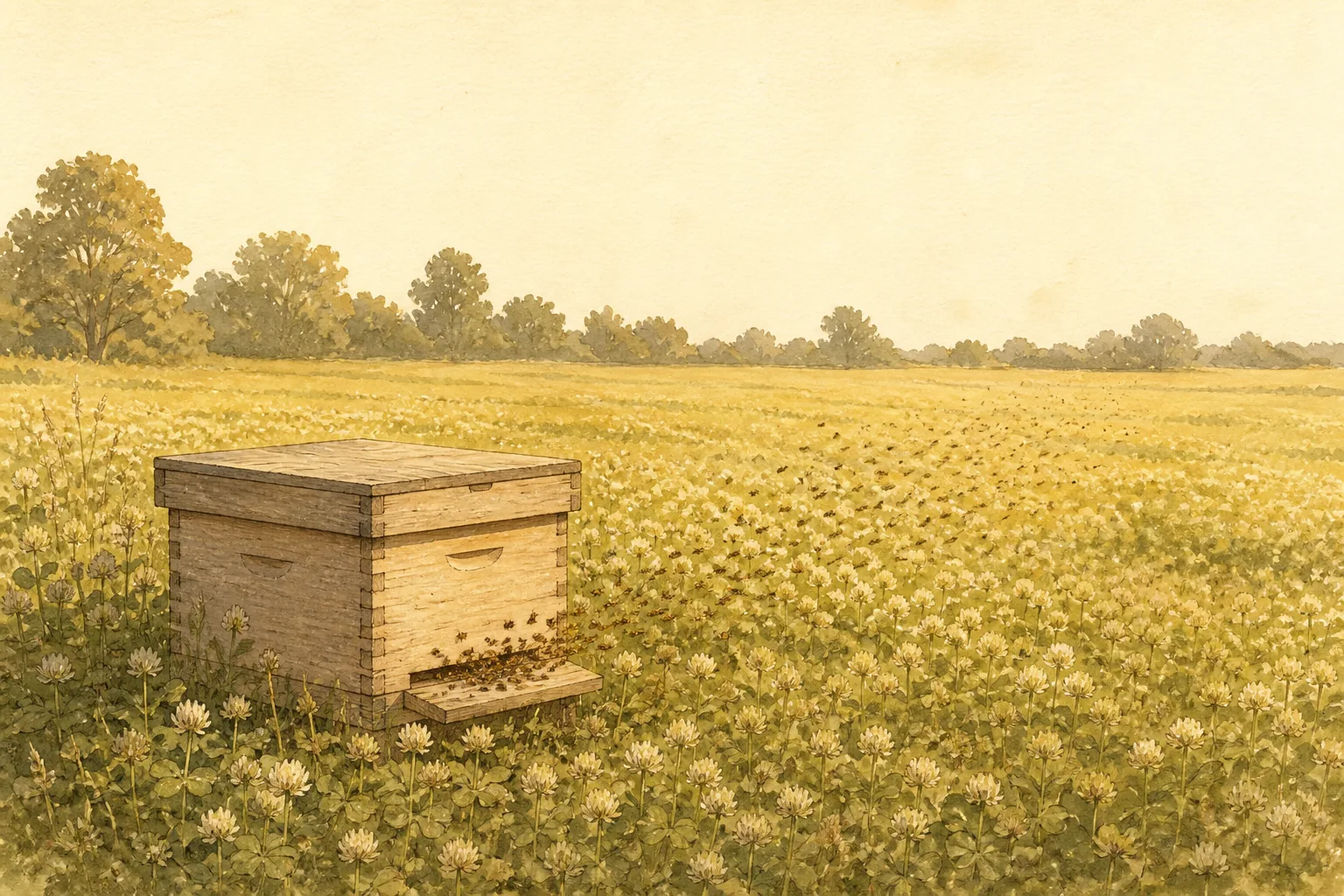
To make a pound of honey, honeybees visit roughly two million flowers. The exact number depends on the plant; a clover blossom gives up a tiny bead of nectar, a basswood flower rather more. But two million is the figure beekeepers and researchers have settled on as a fair average, and it is not an exaggeration.
A foraging bee on one trip visits somewhere between fifty and a few hundred flowers, filling a special stomach with nectar that weighs about as much as she does. She flies home, hands it off, and goes back out. A strong colony in summer sends out tens of thousands of these trips a day.
The miles
Add up the flights, and a pound of honey represents about fifty-five thousand miles of bee flight, a bit more than twice around the Earth. Foragers work within a couple of miles of the hive when they can, farther when they have to. Each bee makes ten or more trips a day in good weather, and a forager lives only about three weeks in summer before she wears out.
One bee’s share
Over her entire life, a single worker bee makes about one-twelfth of a teaspoon of honey. That’s it. The jar in your hand is the lifetime work of a few thousand bees. When you see a beekeeper handle a frame gently, that’s part of why.
Turning nectar into honey
Nectar is mostly water, often seventy or eighty percent. Honey is under eighteen percent water. So the bees have to get rid of most of what they collected. They do this by passing the nectar from bee to bee, each one adding enzymes and holding it in her mouth to let some moisture evaporate, then spreading it in thin films across the comb and fanning it with their wings. On a warm night a hive full of curing nectar sounds like a small engine and smells like a bakery. When a cell is dry enough, the bees seal it with a cap of wax. That’s finished honey, and it will keep indefinitely.
The evaporation is the reason honey is expensive to produce. It takes about four pounds of nectar, and all the work of carrying and fanning it, to end up with one pound of honey.
What a colony can spare
A healthy colony in a good year makes far more honey than it needs. A hive might store a hundred pounds or more over a summer, and it will use forty to sixty of those to get through a northern winter. The rest is what the beekeeper takes. In a poor year, cold or dry or with the bloom rained out, there is little surplus and sometimes none. That’s why the price and availability of single-source honey moves from year to year: it depends on the weather in one place during a few weeks.
Why this matters for the jar
It’s a reason to prefer honey from a beekeeper who can tell you where it came from. Cheap honey exists because it’s blended across continents and, too often, stretched with syrup. The two million flowers are real. The fifty-five thousand miles are real. When a jar says clover from a field in the Midwest, or linden from a hillside in Wisconsin, or tupelo from a river in Florida, that is what you are buying: a season’s work from one place, carried in one bee-load at a time.
We bottle ours by hand in Lake County, Illinois, in one-pound glass jars. Every one of them is two million flowers.