Know your honey · September 2, 2026 · 4 min read
What clover honey tastes like, and why it's the one everyone starts with
The most common honey in America is common for a reason. A guide to clover honey, from the field to what to put it on.
If you have ever had honey and don’t know what kind it was, it was probably clover. Clover honey is the most widely produced honey in the United States, the one in the plastic bear, the one in the packets at the diner, the flavor people mean when they say “honey.” That makes it easy to overlook. It shouldn’t be. Good clover honey, raw and from one place, is one of the best there is.
Where it comes from
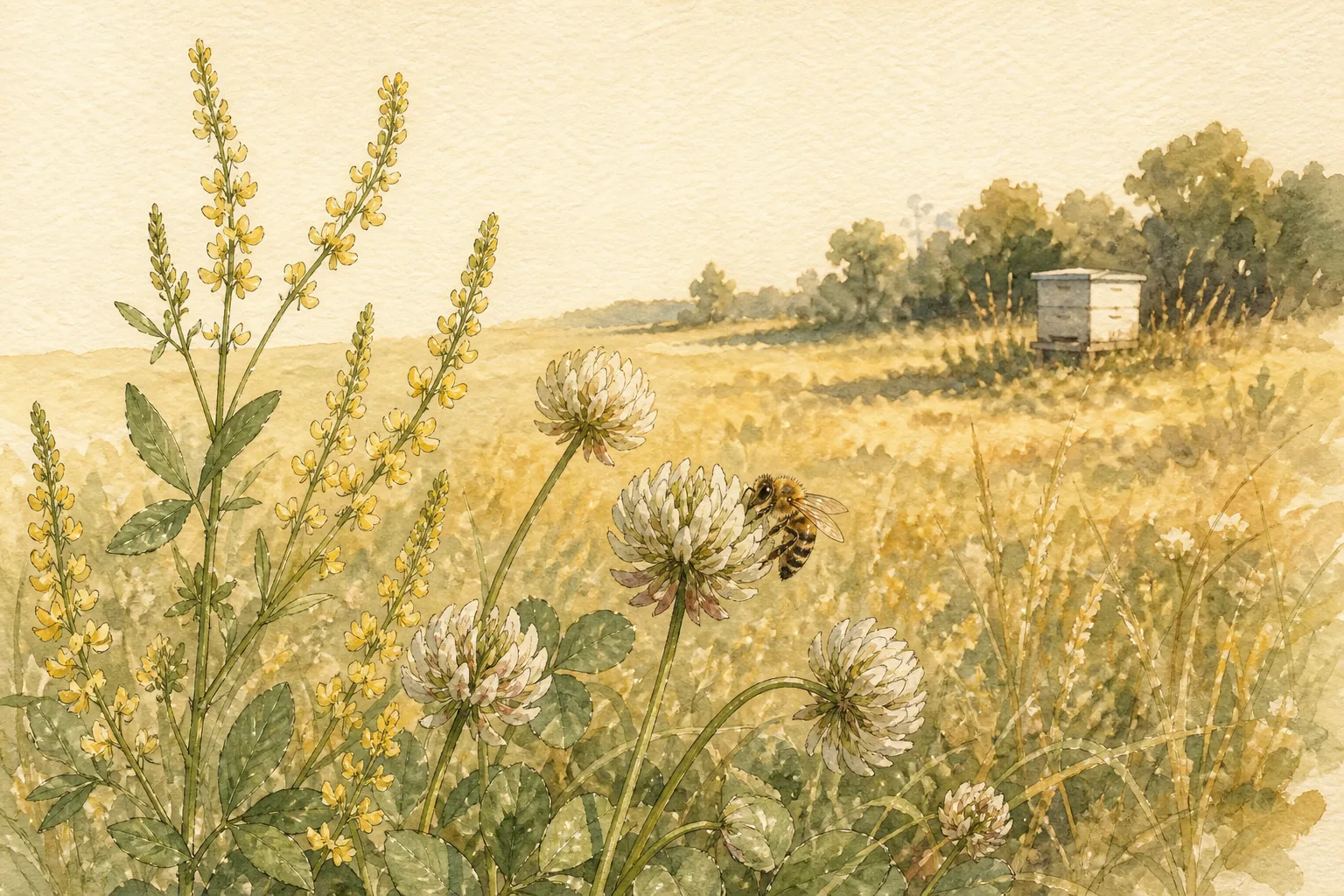
Clover honey isn’t from one plant. It’s from a family of them. The big producers are sweet clover, a tall, loose plant with small yellow or white flowers that grows along roadsides and in hayfields across the Midwest and Great Plains, and white clover, the low creeping one in lawns and pastures. Alsike and red clover contribute in some regions. All of them produce nectar generously and bloom for a long stretch of summer, which is why bees on a clover field fill boxes fast.
Ours comes from sweet-clover fields, harvested in summer at the height of the bloom and bottled in Lake County, Illinois.
What it tastes like
Pale. Clover honey is usually water-white to light amber, and the lighter it is, the milder. The flavor is clean and sweet with a soft warmth behind it that people describe as cinnamon, vanilla, or, in ours, a bit like apple pie. There is no bitterness and very little of the sharp or green edge you find in stronger honeys. It finishes fast and doesn’t linger.
That mildness is the point. Clover doesn’t compete with anything, so it works where a strong honey would take over: in tea, on plain yogurt, drizzled on fruit, stirred into oatmeal, in a vinaigrette. If a recipe just says “honey,” clover is what it expects.
Raw clover versus the bear
The difference between raw clover honey and mass-market clover honey is the difference between an apple from a tree and apple-flavored anything. The bear has been heated and fine-filtered, which strips the aroma, and it’s usually a blend from many sources and often several countries. It tastes sweet.
Raw clover from one field still has the flowers in it. Open the jar and you can smell it. It’s cloudier and it will crystallize, and when it does it turns into a pale, creamy spread that a lot of people prefer to the liquid. Clover sets more readily than most honeys because of its sugar balance, so if you buy a jar and it turns solid in a month, that’s a sign you bought the real thing.
Crystallized clover honey
Because clover sets fine and smooth, it is the honey most often sold as “creamed” or “whipped” honey. Creamed honey is not whipped at all; it’s raw honey seeded with a little already-crystallized honey and held cool so it sets with tiny crystals instead of coarse ones. The result is spreadable, like soft butter. You can do this at home with any jar of raw clover: stir a spoonful of set honey into a jar of liquid honey and leave it somewhere cool for a week.
Three ways to use it
On hot buttered toast, where it melts into the butter and you taste the cinnamon note. In a cup of tea after the tea has cooled enough to drink, so the aroma survives. And in a simple dressing: two spoons of olive oil, one of lemon juice, one of clover honey, a pinch of salt, shaken in a jar. It’s the honey you’ll use up first, and the one to start with if you’re new to raw honey and want to taste what the fuss is about.
Our White Clover Honey comes in a one-pound glass jar. Everything is sold out while we wait on the first bottling; email us and we’ll tell you the day it lands.